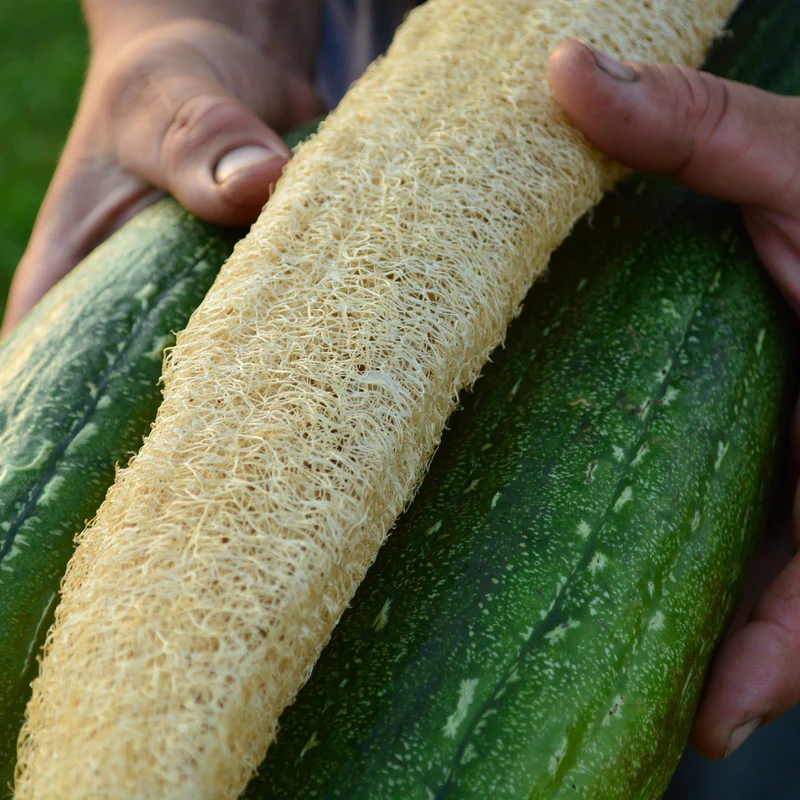
When most people think of luffa (also spelled loofah), they picture that rough, fibrous sponge hanging in their shower. But here’s what might surprise you: that “sponge” isn’t from the sea at all – it’s actually a vegetable! At re-Wild, we’re growing this remarkable plant and would like to show you why it deserves a place in every home.
What Exactly is Luffa?
Luffa belongs to the cucumber family and grows as a climbing vine that produces elongated, cylindrical fruits. When young and tender, these fruits are completely edible and are enjoyed as a vegetable in many Asian and African cuisines. However, when left to mature and dry on the vine, something magical happens – the flesh decomposes naturally, leaving behind a perfect network of fibrous material that creates nature’s own exfoliating sponge.
At Mayfield Family Farm, we’ve been growing luffa organically , and I have to say, it’s one of the most rewarding plants to cultivate. Unlike synthetic sponge production which requires significant chemical processing and energy, luffa grows happily with just sunshine, water, and organic care.
Why We Choose Organic Luffa Growing
Growing luffa organically isn’t just better for your skin – it’s better for everything! Here’s what we’ve learned from our farming experience:. They’re incredibly water-efficient , thriving on rainwater . We love that every part of the luffa plant serves a purpose – young fruits for eating, mature fruits for sponges, leaves for composting, and even the seeds can be saved for next season or pressed for oil.
One of my favourite things about growing luffa is watching the bees and butterflies that flock to the flowers. It’s wonderful knowing that our luffa patch is supporting local biodiversity and helping our entire farm ecosystem thrive.
Incredible Benefits for Your Skin
Luffa provides natural exfoliation that removes dead skin cells. The natural texture stimulates blood circulation, promoting healthy, glowing skin that feels incredibly smooth. Unlike synthetic sponges that can harbour bacteria in their porous structure, luffa has natural antimicrobial properties. When properly dried and maintained, luffa sponges resist bacterial growth, making them more hygienic for daily use.
Despite its exfoliating properties, luffa is surprisingly gentle and suitable for most skin types, including sensitive skin, just remember they are hard when dry so wet them before use, as this will soften it. The natural fibres soften when wet, providing customisable exfoliation – I use it firm for my heels, but gently on my face and body.
Regular use of luffa helps remove the barrier of dead skin cells, allowing your natural skincare products to penetrate more effectively. This means you get maximum benefit from those precious organic oils and serums in your skincare routine – like our re-Wild products!
Environmental Champions: Why Luffa Beats Synthetic Every Time
When your luffa sponge reaches the end of its life (typically 1-3 months with daily use), it can be composted completely. Compare this to synthetic sponges made from petroleum-based materials that persist in landfills for decades! Our luffa sponges require minimal packaging and can often be sold completely plastic-free. There’s no chemical processing needed – unlike synthetic sponges that require energy-intensive manufacturing processes using petroleum derivatives and chemical foaming agents, luffa sponges are processed using only water and natural drying.
Choosing locally grown luffa supports sustainable farming practices.
Versatile Kitchen Companion
One thing I love about luffa is how useful it is beyond the bathroom.
It’s perfect for washing delicate glassware and non-stick cookware without scratching surfaces. I use it for cleaning fresh produce from our garden, removing soil without damaging the skin. .
When we’re finished with a luffa in the kitchen, we simply toss it in our compost bin – no guilt, no waste!
Making the Switch: What to Look For
When choosing luffa products, look for organically grown varieties free from synthetic pesticides, naturally processed without chemical bleaching or treatments, and locally sourced when possible to reduce environmental impact. Try to find ones with minimal or no packaging too.
Caring for Your Luffa
To get the most out of your luffa sponge, rinse it thoroughly after each use, shake out excess water and hang it to dry in a well-ventilated area. I deep clean mine weekly by soaking in hot water with a few drops of tea tree oil. Replace every 1-4 months or when it begins to break down, then compost the old sponge and start fresh!
The re-Wild Way
At re-Wild, we believe in the power of returning to natural solutions that work in harmony with our bodies and environment. Luffa perfectly embodies this philosophy – it’s a plant that gives us multiple gifts while asking for nothing more than sunshine, water, and care.
By choosing luffa over synthetic alternatives, you’re not just making a choice for your skin’s health – you’re supporting sustainable farming practices and reducing your environmental footprint. Every luffa sponge represents a small step towards a more natural, sustainable lifestyle.
We encourage you to always do your own reading and research on the incredible natural alternatives that creation and nature provides for us. The information may blow your socks off! Ready to make the switch? Your skin, your home, and the planet will thank you for choosing this remarkable natural wonder.
Sometimes, the most innovative solution is the one that’s been growing quietly in gardens for thousands of years.